Home / Testing Methodology
How Premium Espresso Lab Evaluates Espresso Machines
Our espresso machine testing methodology is designed to show what a product is like to set up, use, clean and own. Every review states whether a conclusion comes from hands-on evaluation, manufacturer documentation, independent testing, owner feedback or a combination.
Before testing begins
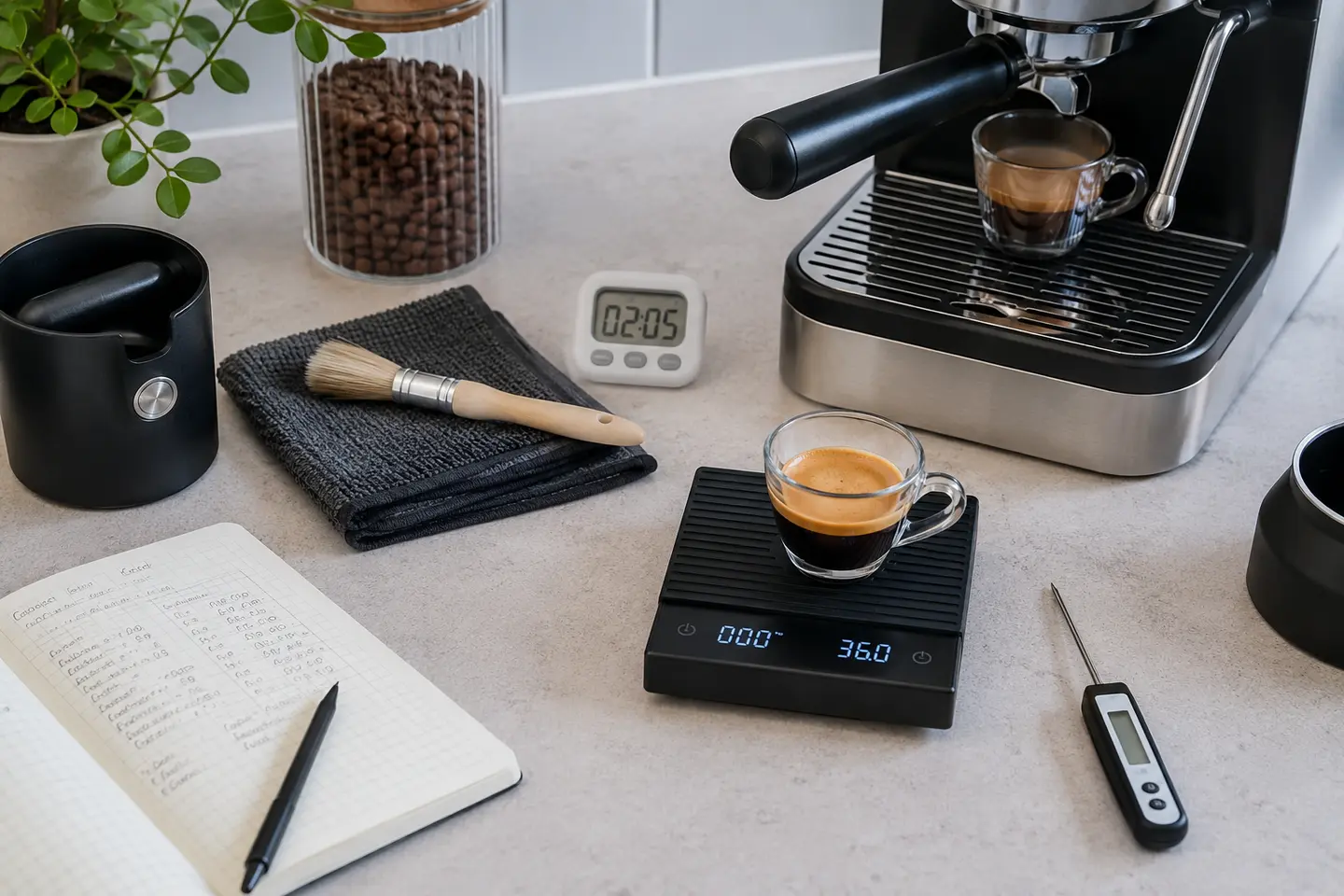
We record the model, market, supplied accessories, software or firmware details, water setup and coffee used. We also review the manual and current manufacturer specifications. This creates a clear baseline and reduces the risk of confusing a product revision with a universal feature.
Where useful, our procedures are informed by published coffee research and the Specialty Coffee Association standards framework. Premium Espresso Lab does not claim SCA certification, laboratory accreditation or professional-barista credentials.
Setup and daily workflow
Setup experience
We document unpacking, water preparation, assembly, configuration and the route to a first usable drink. Instructions, accessibility and avoidable confusion are noted.
Ease of use
Controls, labels, prompts and the learning curve are assessed for both first-time and repeated use. Automation is considered alongside the control it removes or preserves.
Workflow speed
We consider warm-up, grinding, preparation, extraction, steaming and the reset between drinks. Timing is reported with the procedure and conditions that produced it.
Espresso consistency
Dose, beverage yield and extraction time are tracked across repeated preparations. Sensory notes are contextual, because coffee, water and recipe choices materially affect flavor.
Grinder, milk and temperature evaluation
Grinder adjustment and usability
For machines with an integrated grinder, we assess adjustment range, dose control, retention, access to the burrs and the effort required to change coffees. A machine is not penalized simply because dialing in requires learning; we explain the work involved.
Milk-texturing performance
We examine steam readiness, texture control, repeatability, pitcher positioning and the transition between espresso and milk. Automatic systems are evaluated for convenience and consistency. Manual wands are evaluated for usable control and learning demands.
Temperature consistency
Temperature observations use practical consumer tools and a stated procedure. They are not presented as laboratory measurements. We distinguish heater-ready claims from the thermal condition of the portafilter, cup and full brewing path.
Noise
We consider grinder, pump and steaming noise during realistic use. If sound-level readings are reported, the meter, distance, room and operating stage will be identified.
Cleaning, build and long-term ownership
Cleaning requirements and maintenance
Daily rinsing, steam-wand care, drip-tray handling and periodic cleaning cycles are documented. We also examine filters, descaling, cleaning tablets and the clarity of maintenance prompts.
Build quality
We assess fit, finish, control feel, removable parts and areas that receive frequent handling. Appearance alone is not treated as proof of durability, and reliability conclusions require sufficient use.
Consumable costs
Filters, cleaners, replacement wear items and other recurring supplies are identified when reliable pricing is available. Costs can vary by location, water hardness and usage, so assumptions are stated.
Long-term ownership considerations
Service access, parts availability, warranty terms, countertop footprint and the ease of living with the machine all matter. We revisit conclusions when credible long-term evidence becomes available.
Overall value
Overall value reflects price, capability, drink quality, usability, maintenance burden, flexibility and fit for the intended user. It is not a simple feature count. A less automated machine can be the better value for one household, while a guided workflow can be worth more to another.
Read the Editorial Policy for our sourcing rules, browse our espresso machine reviews, or learn more about Premium Espresso Lab.